Digital transformation strategies in 2025 are no longer about adopting random tools or launching isolated AI pilots. They are about unifying systems, redesigning workflows, building cyber resilience early, and making AI useful inside real business processes. Companies that treat transformation as a systems project — not a trend experiment — consistently see better outcomes.
If you searched digital transformation strategies, you’re likely trying to figure out:
-
Where to start
-
What frameworks work today
-
Who owns transformation internally
-
What KPIs prove progress
-
How AI actually fits into business
-
What mistakes to avoid
This guide gives you all of that, clearly and practically. It reads like a mix of a consulting framework, a CIO playbook, and a real-world business guide — without drowning you in theory or repeating the same buzzwords. Let’s get into it.
What is a Digital Transformation Strategy?
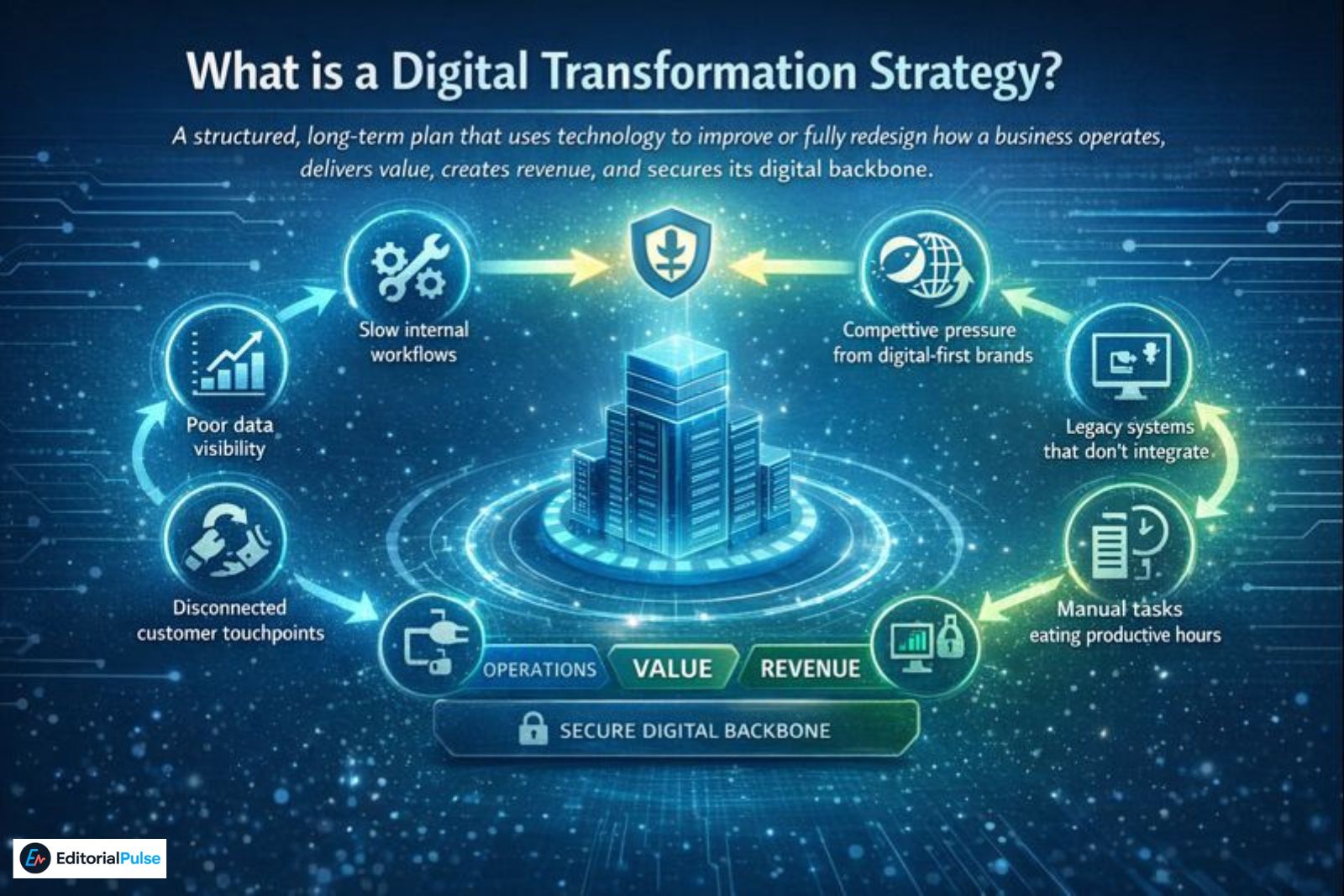
A digital transformation strategy is a structured, long-term plan that uses technology to improve — or fully redesign — how a business operates, delivers value, creates revenue, and secures its digital backbone.
Core business challenges it solves:
-
Slow internal workflows
-
Poor data visibility
-
Disconnected customer touchpoints
-
Manual tasks eating productive hours
-
Legacy systems that don’t integrate
-
Competitive pressure from digital-first brands
2025 reality: 54% of companies now report a skills and expertise gap as the top barrier to successful transformation, making adoption and reskilling essential to strategy.
The 4 Types of Digital Transformation
| Type | What it changes | Business outcome |
|---|---|---|
| Process Transformation | Internal workflows | Lower cost, faster delivery |
| Business Model Transformation | Revenue generation | New income streams |
| Domain Transformation | Markets and industries | Expansion into new sectors |
| Cultural/Org Transformation | Skills, mindset, collaboration | Higher adoption & innovation |
The 4 Pillars vs 5 Pillars of Digital Transformation
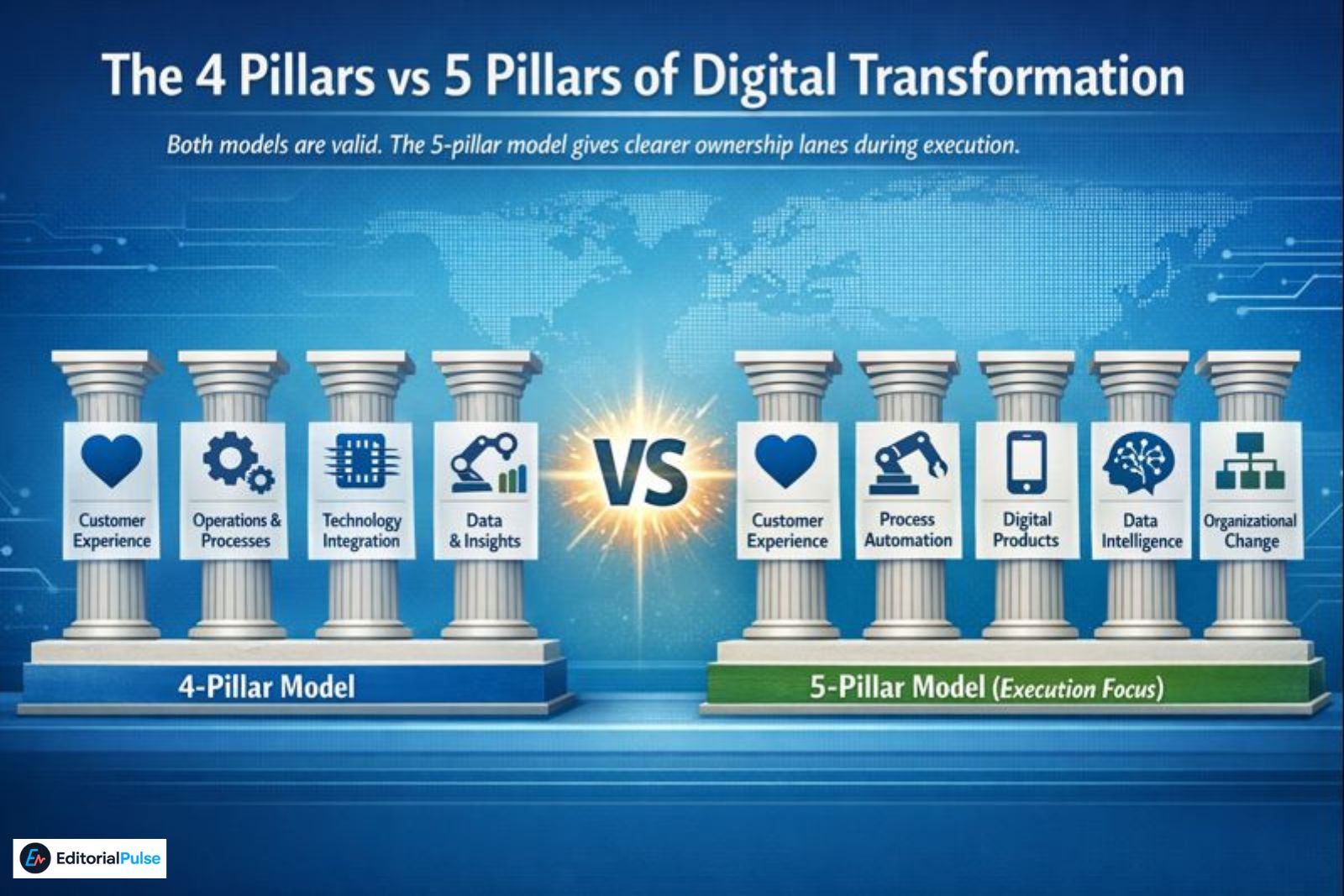
4-Pillar Model
-
Customer Experience
-
Operations & Processes
-
Technology Integration
-
Data & Insights
5-Pillar Model (Execution Focus)
-
Customer experience
-
Process automation
-
Digital products/services
-
Data intelligence
-
Organizational change
Both models are valid. The 5-pillar model gives clearer ownership lanes during execution.
The 4-Phase Digital Transformation Roadmap (2025 Framework)
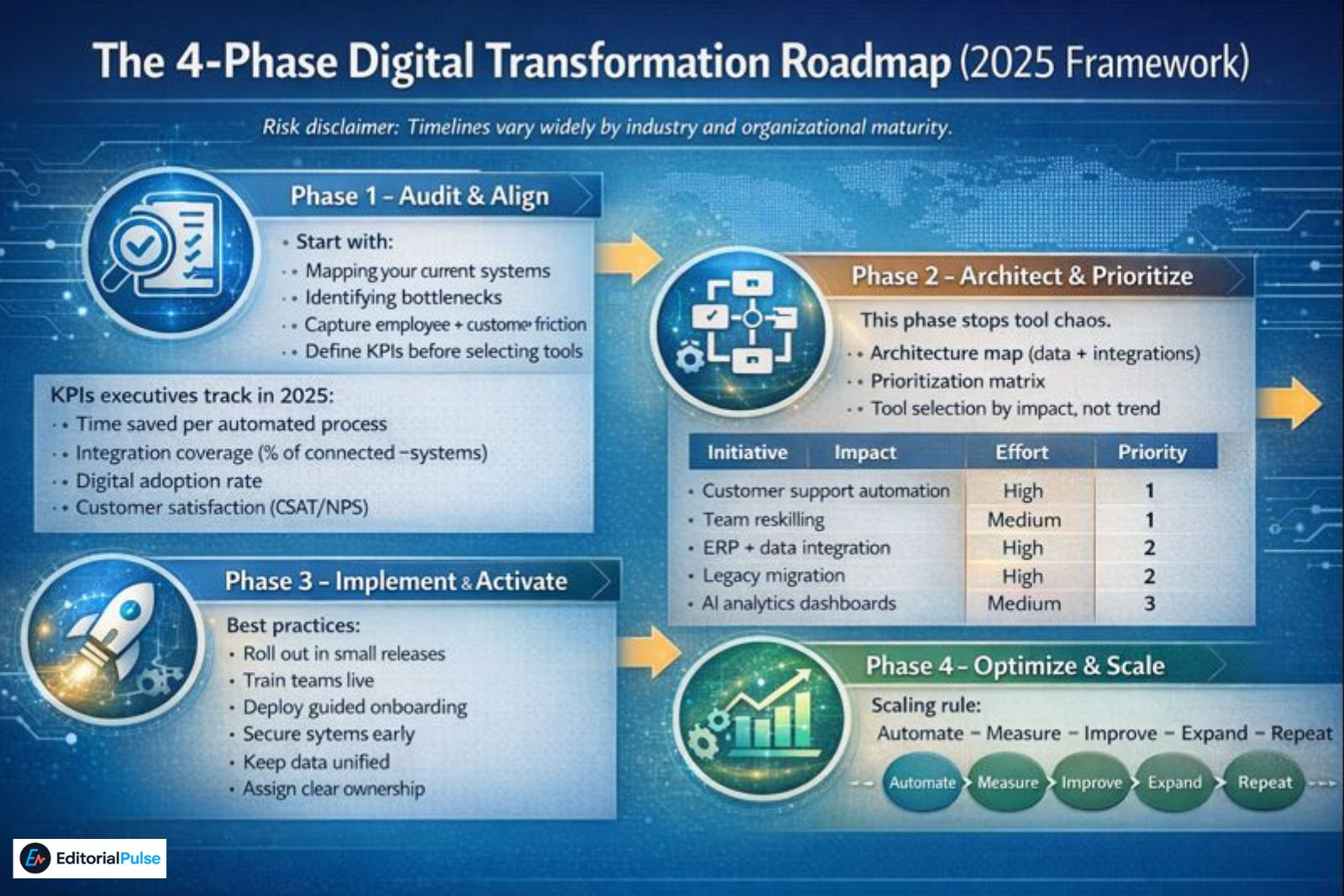
- Phase 1 – Audit & Align
- Phase 2 – Architect & Prioritize
- Phase 3 – Implement & Activate
- Phase 4 – Optimize & Scale
Risk disclaimer: “Timelines vary widely by industry and organizational maturity.”
Phase 1 – Audit & Align
Start with:
-
Mapping your current systems
-
Identifying bottlenecks
-
Capturing employee + customer friction
-
Defining KPIs before selecting tools
KPIs executives track in 2025:
-
Time saved per automated process
-
Integration coverage (% of connected systems)
-
AI-assisted decision accuracy (early-stage but fast maturing)
-
Digital adoption rate
-
Customer satisfaction (CSAT/NPS)
-
ROI per initiative (reviewed quarterly)
Phase 2 – Architect & Prioritize
This phase stops tool chaos.
Deliverables:
-
Architecture map (data + integrations)
-
Prioritization matrix
-
Tool selection by impact, not trend
| Initiative | Impact | Effort | Priority |
|---|---|---|---|
| Customer support automation | High | Medium | 1 |
| Team reskilling | High | Medium | 1 |
| ERP + data integration | High | High | 2 |
| Legacy migration | High | High | 2 |
| AI analytics dashboards | Medium | Medium | 3 |
Phase 3 – Implement & Activate
Best practices:
-
Roll out in small releases
-
Train teams live
-
Deploy guided onboarding
-
Secure systems early
-
Keep data unified
-
Assign clear ownership
Phase 4 – Optimize & Scale
Scaling rule:
Automate → Measure → Improve → Expand → Repeat
Quantified Mini Cases (Real-World ROI Examples)
-
A logistics company unifying data and automating warehouse allocation saw 32% faster order processing and 41% fewer inventory delays.
-
A manufacturing plant using IoT + AI anomaly detection achieved 27% reduction in unplanned downtime within 9 months.
-
A service business centralizing scheduling and invoicing reduced payment delays by 22% and cut internal admin hours by 35%.
These are directional examples, not guarantees.
2025 Trends That Matter vs Ones That Don’t
| Rising Priorities | Declining Priorities |
|---|---|
| Agentic AI (autonomous workflows, rapidly maturing) | Metaverse pilots without ROI |
| Process mining | Chatbots with no integrations |
| Composable tech stacks | “AI for everything” experiments |
| Cyber resilience | Roadmaps without KPIs |
| Hybrid human + AI support | Tool-first strategy |
Who Owns Digital Transformation Internally?
| Owner | Focus |
|---|---|
| CIO / CTO | Cloud, integrations, security |
| COO | Workflow redesign, automation ROI |
| CDO | Customer + product + data led DX |
| CEO | Sponsorship + accountability |
2025 best practice: One accountable owner + cross-functional delivery team.
FAQs
Q1. What is a digital transformation strategy in 2025?
A 2025 digital transformation strategy is a systems-first plan that unifies data, automates workflows, embeds AI inside processes, secures infrastructure early, assigns clear ownership, and measures ROI through adoption KPIs.
Q2. How to build digital transformation strategies that rank in 2025?
Build strategies by targeting integration, automation, KPIs, ownership, and adoption. Publish content using Article + FAQ + HowTo + Breadcrumb schema, include real examples, and answer PAA questions concisely to capture AI Overview visibility.
Q3. What are the 4 main digital transformation strategies?
The 4 main strategies are:
Process transformation, business model reinvention, domain expansion, and cultural reskilling, each focused on efficiency, revenue, markets, and people.
Q4. What are the 5 steps of digital transformation strategy?
A practical 2025 sequence is:
Audit systems → Map architecture → Prioritize by ROI → Roll out in increments → Train teams + Secure early → Optimize and scale, tracked quarterly.
Q5. Who leads digital transformation in an enterprise?
In 2025, leadership depends on focus:
CIO/CTO (systems + cloud + security), COO (workflows + automation ROI), CDO (customer + product + data), and CEO (sponsor + accountability). The best programs assign one accountable owner.
Q6. What KPIs prove digital transformation success?
Modern KPIs include: Time saved, integration coverage, AI accuracy, adoption rate, CSAT/NPS, ROI per initiative, security resilience, and admin hours reduced. These are operational metrics, not vanity stats.
Q7. Why do digital transformation strategies fail?
They fail due to: tool-first thinking, weak adoption, siloed data, no KPIs, unclear ownership, no architecture, and late security planning. Companies that skip the plan phase enter endless tool replacement cycles.
Q8. How does AI support digital transformation?
AI supports transformation when embedded into integrated, automated workflows like forecasting, anomaly detection, support automation, process mining, and decision assistance. In 2025, agentic AI is early-stage but rapidly maturing, driving autonomous multi-step execution.
Conclusion
Digital transformation strategies in 2025 succeed when they are system-driven, KPI-measured, adoption-focused, and security-anchored early. AI only creates value when it sits inside integrated workflows, owned by real teams, tracked by real KPIs, and improved in stages.
The companies that scale fastest follow one rhythm:
Audit → Plan → Deploy → Improve → Expand. Repeat.
Related: Small Business Debt Recovery: The 2025 Complete Guide
| Disclaimer: This article is for informational purposes only and does not constitute professional advice. Results of digital transformation initiatives vary by industry, organizational maturity, and implementation. Timelines, ROI, and outcomes mentioned are illustrative and may not reflect actual results for every organization. |