Why You Keep Reaching for Your Phone (Even When You Don’t Want To)
You’re not checking your phone because you lack discipline.
You’re checking it because your brain wants relief.
When focus drops, or boredom creeps in, your brain looks for dopamine—the neurotransmitter involved in motivation, reward, and attention. Phones deliver it quickly and unpredictably. Notifications, feeds, and short-form content rely on variable reward patterns, a principle from behavioral psychology that keeps the brain coming back for more.
The issue isn’t dopamine itself.
It’s over-reliance on digital stimulation as the primary source of relief.
As attention becomes more fragmented in 2026, many people are realizing that constant scrolling doesn’t just affect productivity—it affects emotional regulation, creativity, and even critical thinking in the age of AI, where sustained attention matters more than ever.
That’s where a dopamine menu comes in.
What Is a Dopamine Menu?
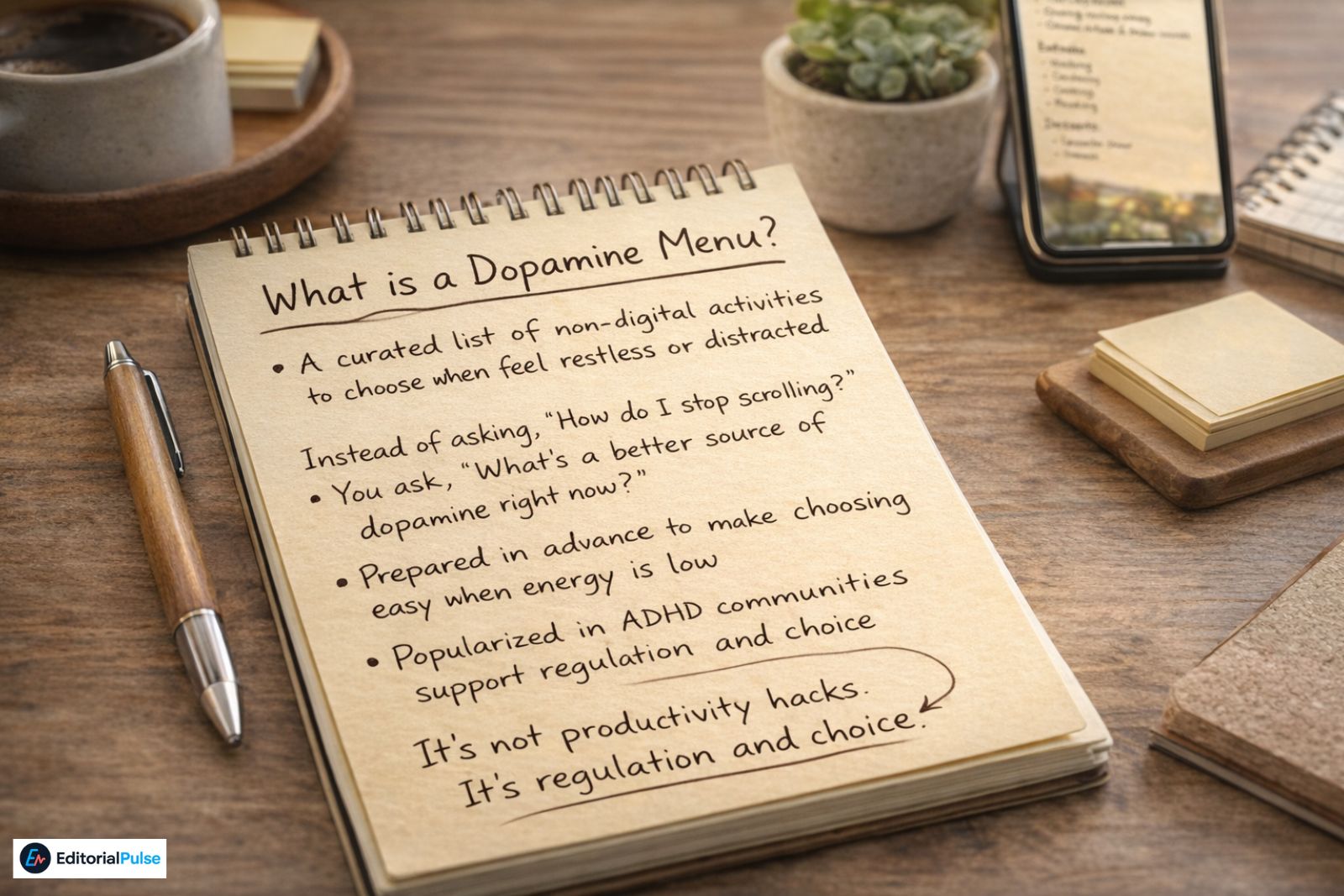
A dopamine menu is a curated list of non-digital activities you can choose from when you feel restless, distracted, or tempted to check your phone.
Instead of asking, “How do I stop scrolling?”
You ask, “What’s a better source of dopamine right now?”
The menu is prepared ahead of time, so you don’t have to think when your energy is low. The concept was popularized in ADHD communities (notably by Jessica McCabe of How to ADHD) and aligns closely with behavioral activation and executive-function supports used in therapy and coaching.
This isn’t about productivity hacks.
It’s about regulation and choice.
Digital Minimalism 2.0: Why This Tool Fits the Moment
Early digital minimalism focused on cutting apps, limiting screen time, or going offline entirely. In practice, that approach often failed because it relied on restriction.
Digital Minimalism 2.0 takes a different path:
-
Fewer rules
-
More intention
-
Better substitutes
A dopamine menu fits this model perfectly. It doesn’t demand a full digital detox. Instead, it reduces dependence on screens by making non-digital dopamine easier to access—especially in moments of stress or boredom.
The Dopamine Menu Framework (Simple and Visual)
The most effective dopamine menus are organized by time and energy, not by goals or self-improvement ideals.
The 2026 Dopamine Menu Table
| Menu Section | Time | Goal | The “Why” |
|---|---|---|---|
| Appetizers | ~5 min | Interrupt the urge | Resets the sensory system |
| Entrées | ~30 min | Restore focus | Rebuilds sustained attention |
| Desserts | Varies | Intentional joy | Prevents deprivation burnout |
This structure removes the biggest barrier to habit change: “I don’t have the energy for that.”
Appetizers: 5-Minute Dopamine Without a Screen
Appetizers are for moments when your hand is already reaching for your phone. They are small, physical, and deliberately specific.

Hyper-Specific Appetizer Ideas
-
Sorting a junk drawer for exactly five minutes
-
Washing one mug slowly with warm water
-
Standing outside and naming five sounds you hear
-
Stretching your calves against a wall
-
Lighting a candle and watching the flame
-
Rearranging books on a single shelf
These work because they:
-
Engage the body
-
Have a clear endpoint
-
Create a small sense of completion
Finishing even a tiny task triggers a reward signal in the brain, which helps with task initiation.
Entrées: 30-Minute Activities That Rebuild Focus
Entrées are for when you have a bit more capacity and want something that feels grounding rather than draining.

Entrée Ideas
-
Walking without your phone
-
Gardening or caring for plants
-
Cooking a simple meal
-
Journaling or writing by hand
-
Drawing, knitting, or crafting
-
Yoga, swimming, or strength training
-
Reading a physical book
Many of these are commonly used in behavioral activation, a CBT-based approach that supports mood and motivation by increasing meaningful action.
Desserts: Enjoyment Without the Spiral
Desserts aren’t bad. The problem is when they become automatic.

Desserts work best when they are:
-
Chosen intentionally
-
Time-bounded
-
Enjoyed without guilt
Examples:
-
Watching a favorite show in the evening
-
A weekend hobby
-
A social activity you genuinely look forward to
This prevents the burnout that often follows overly strict “detox” approaches.
The Skill That Makes This Work: Urge Surfing
A dopamine menu becomes far more effective when paired with urge surfing, a technique developed by psychologist Dr. G. Alan Marlatt.
Urge surfing looks like this:
-
You notice the urge to check your phone
-
You pause instead of reacting
-
You observe the urge like a wave—rising, peaking, falling
-
You let it pass, then choose from your menu
Most urges fade within minutes if they aren’t acted on. You don’t suppress them—you simply don’t obey them.
How to Build Your Own Dopamine Menu
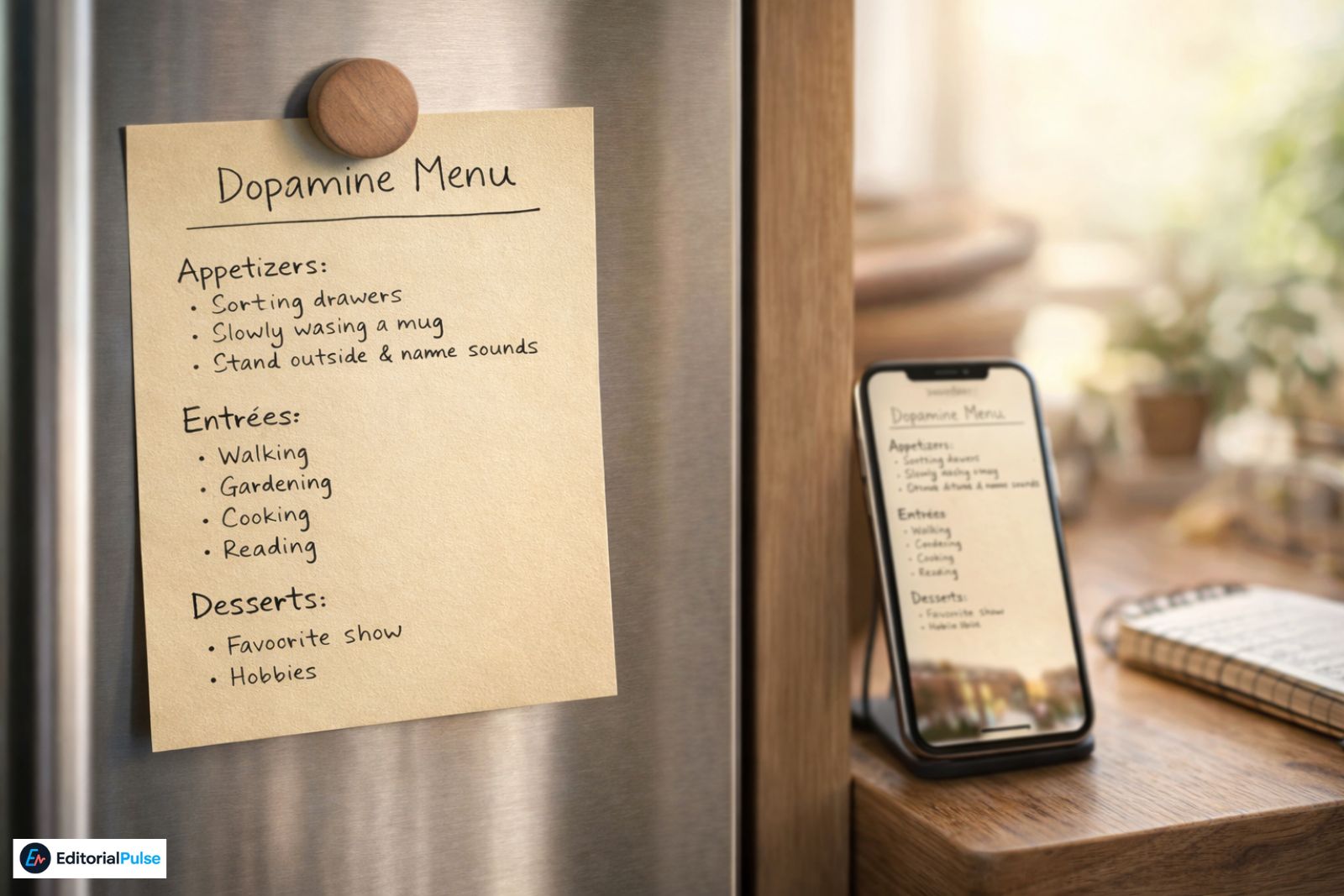
Step 1: Identify What Actually Helps
Look for moments when you felt calmer or clearer without a screen. Those activities belong on your menu.
Step 2: Keep It Short
A strong menu usually includes:
-
5–7 appetizers
-
4–6 entrées
-
2–3 desserts
Too many options create friction.
Step 3: Make It Impossible to Miss
Visibility matters more than motivation.
-
Put it on your desk or fridge
-
Keep it in a notebook
-
Take a photo and set it as your phone lock screen
If you see the menu at the moment of temptation, you’re far more likely to use it.
The Digital Detox Myth (Clarified)
You can’t detox from dopamine. It’s a neurotransmitter your brain needs to function.
What people usually mean by a digital detox is reducing overstimulation so the brain can gradually become more responsive to everyday rewards again.
A dopamine menu supports this by:
-
Reducing reliance on constant digital input
-
Reintroducing slower, embodied sources of reward
-
Supporting attention recovery over time
This is regulation—not restriction.
Why Dopamine Menus Are Especially Helpful for ADHD
ADHD often involves difficulty with:
-
Task initiation
-
Sustaining attention
-
Tolerating boredom
A dopamine menu lowers the activation energy required to start something helpful. Instead of making a decision in a low-motivation moment, you simply choose from the menu.
It doesn’t treat ADHD—but it supports executive function in a practical, compassionate way.
FAQs
Q. What is a dopamine menu?
A dopamine menu is a curated list of non-digital activities you can use when you feel bored, distracted, or tempted to scroll your phone. It helps regulate dopamine, improve focus, and replace impulsive digital habits with healthier, intentional actions.
Q. How is a dopamine menu different from a digital detox?
Unlike a digital detox, which restricts screen use, a dopamine menu redirects dopamine to healthy, non-digital sources. You’re not eliminating pleasure; you’re replacing impulsive scrolling with activities that support attention, motivation, and emotional regulation.
Q. Does a dopamine menu really work for focus and productivity?
Yes. Many people, including those with ADHD, report improved focus, reduced phone use, and better motivation over time. The key is consistency, menu visibility, and choosing activities that reliably boost dopamine without screens.
Q. Is urge surfing scientifically supported?
Absolutely. Urge surfing is a clinically validated technique used in mindfulness-based therapy and addiction recovery. It helps manage impulses by observing urges without reacting, making it a perfect companion to a dopamine menu.
Q. Who benefits most from a dopamine menu?
A dopamine menu is especially helpful for people with ADHD, phone overuse, burnout, or attention difficulties. It supports executive function, helps manage distraction, and encourages healthier dopamine regulation throughout the day.
Final Thoughts
A dopamine menu doesn’t ask you to be stricter with yourself.
It asks you to be prepared.
In an era of AI-driven content, constant stimulation, and shrinking attention spans, tools like this matter—not just for productivity, but for critical thinking in the age of AI.
You don’t need less dopamine.
You need better sources—and a system that helps you choose them.
Related: Turning My Life Around With Crypto: What Actually Works in 2025
| Disclaimer: This article is for informational purposes only and is not a substitute for professional medical, mental health, or ADHD treatment. Always consult a qualified healthcare provider for personalized advice. Results may vary. |