In 2026, protecting your privacy no longer means installing antivirus software and hoping for the best.
AI-generated phishing messages can now mimic real colleagues, writing styles, and ongoing conversations. Cloud environments change daily, often faster than teams—or individuals—can track. A single misconfiguration or delayed update can expose sensitive data within minutes.
This is why security leaders and analysts increasingly talk about the Digital Immune System (DIS).
A Digital Immune System is a strategy—not a product—designed to detect, respond to, and recover from digital threats automatically, much like the human immune system identifies and neutralizes pathogens before they cause serious harm.
While the broader global cybersecurity market is measured in the hundreds of billions, analysts project that Digital Immune System–specific solutions and platforms will reach approximately $30–35 billion by 2026, driven by AI-powered phishing, software supply chain attacks, and cloud complexity. More importantly, DIS reflects a deeper shift: from static, checklist-based security to adaptive, resilience-focused privacy protection.
This guide explains what a Digital Immune System really is, why it matters for privacy in 2026, and how you can begin building one using three practical “digital vaccines.”
What Is a Digital Immune System (DIS)?

A Digital Immune System is not something you install—it’s something you design.
The concept, popularized by Gartner as a top strategic technology trend, brings together:
-
Observability and real-time monitoring
-
Automation and AI-driven response
-
Secure software development practices
-
Continuous testing and learning
The goal is simple:
detect problems early, contain them automatically, and recover before real damage occurs.
From a privacy perspective, a DIS helps:
-
Reduce how long attackers go undetected
-
Limit how much data is exposed during incidents
-
Prevent small failures from becoming public breaches
Just as your biological immune system works quietly in the background, a Digital Immune System operates continuously—often without requiring constant human attention.
Why Privacy Needs a Digital Immune System in 2026
Privacy threats have fundamentally changed.
The Reality in 2026
-
AI-powered phishing adapts in real time, making traditional “check the link” advice obsolete
-
Cloud-first infrastructure dramatically increases the blast radius of small errors
-
Software supply chain attacks target open-source libraries and third-party vendors
-
Always-on data collection magnifies the cost of every mistake
Traditional security tools still matter, but they are often siloed and reactive. Modern privacy failures rarely come from one dramatic hack—they emerge from weak signals ignored too long.
A Digital Immune System addresses this gap by making privacy protection:
-
Continuous instead of periodic
-
Automated instead of manual
-
Preventive instead of purely reactive
DIS supports privacy law compliance, but it goes further—focusing on risk reduction and resilience, not just passing audits.
The Core of DIS: Three Digital Vaccines
To make the concept practical, think of a Digital Immune System as being built on three digital vaccines. Each strengthens your ability to resist, detect, and recover from privacy threats.
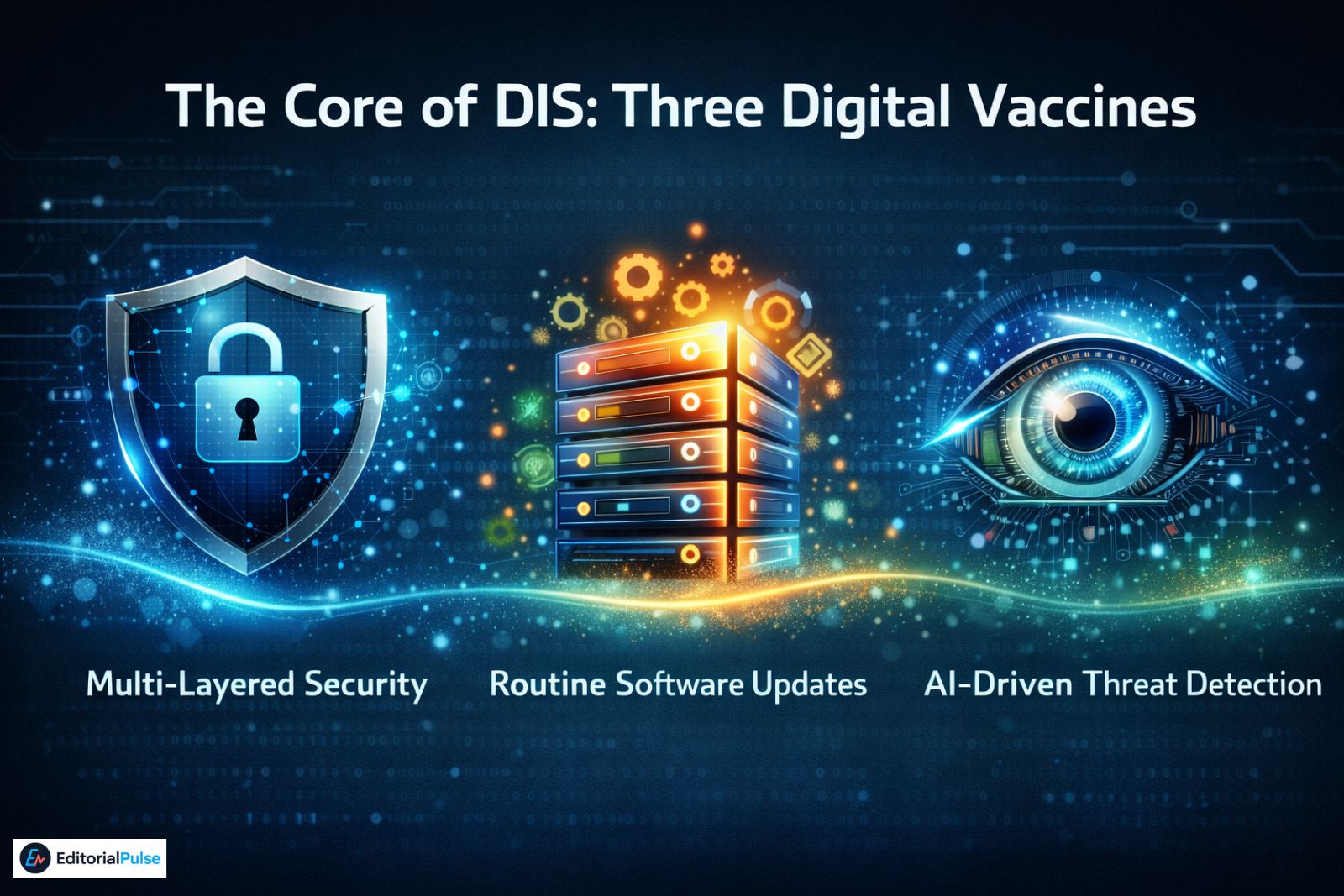
🛡️ Digital Vaccine #1: Multi-Layered Security
No immune system relies on a single defense.
Multi-layered security combines protections across:
-
Devices
-
Networks
-
Applications
-
Identity and access
If one layer fails, another is already in place.
Examples include:
-
Zero-trust access models
-
Encryption at rest and in transit
-
Network segmentation
-
Behavioral monitoring rather than static rules
For privacy, this limits lateral movement and reduces how much data an attacker can access—even after an initial breach.
🧼 Digital Vaccine #2: Routine Software Updates (Digital Hygiene)
Outdated software is the digital equivalent of a weakened immune system.
Many major privacy incidents exploit known vulnerabilities that were never patched. Routine updates:
-
Close documented security gaps
-
Improve detection accuracy
-
Reduce exposure to automated attacks
In a Digital Immune System, updates are:
-
Automated where possible
-
Continuously tested
-
Deployed with rollback mechanisms
This transforms updates from an operational burden into a core privacy defense.
🤖 Digital Vaccine #3: AI-Driven Threat Detection
Attackers use AI. Defenders must do the same.
AI-driven detection systems analyze:
-
User behavior
-
Network traffic patterns
-
System anomalies in real time
Instead of relying solely on predefined rules, these systems learn what “normal” looks like and flag deviations early—often before sensitive data is accessed.
For privacy protection, this enables:
-
Faster detection of account takeovers
-
Earlier identification of insider threats
-
Discovery of silent data exfiltration
This is where the immune metaphor becomes real: the system adapts as threats evolve.
Also Check: Is Browser lol Safe? What It Really Does (and Doesn’t) in 2025
Sidebar: What a Personal Digital Immune System Looks Like in 2026
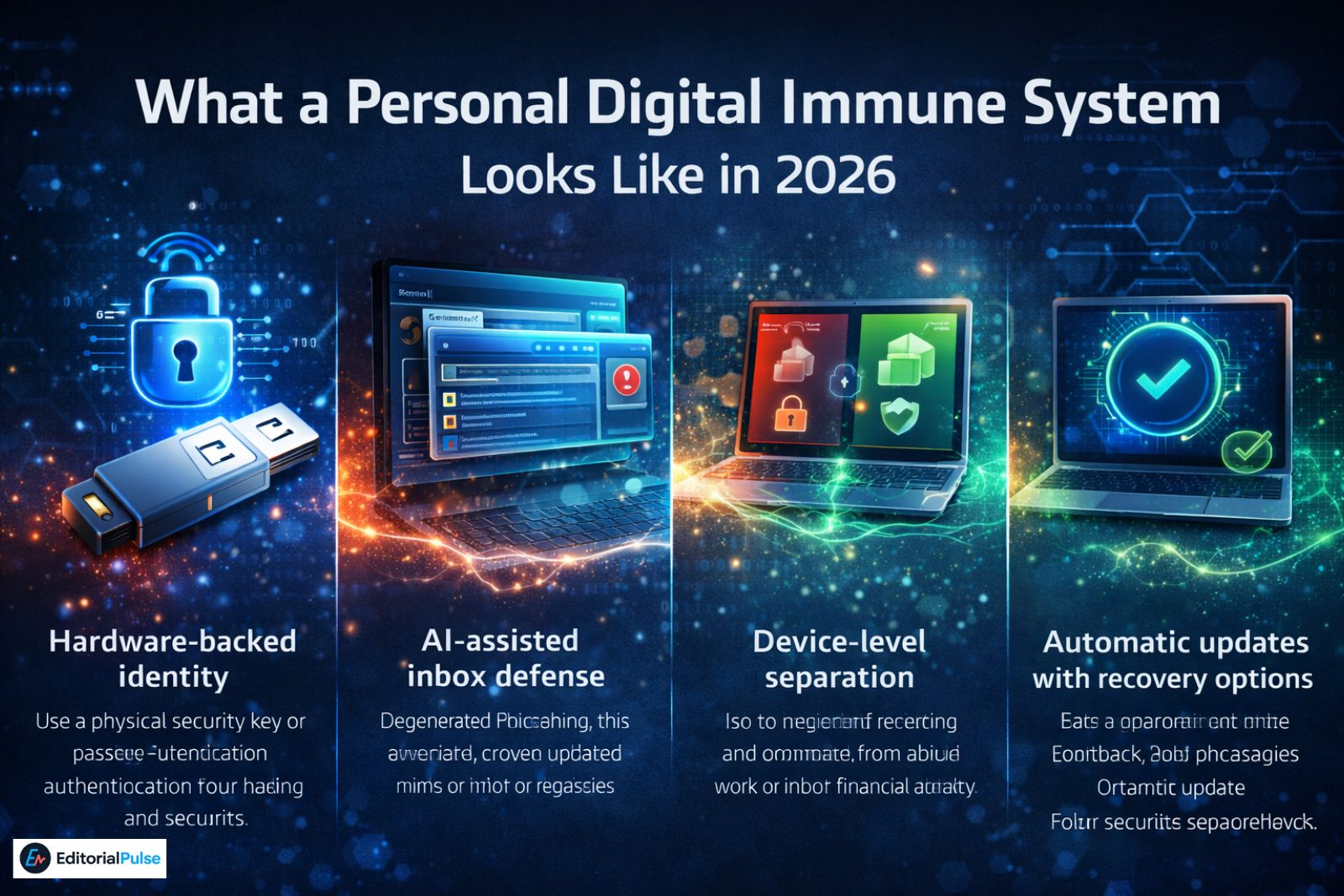
Building a personal Digital Immune System isn’t just about tools—it’s also about judgment. Knowing which alerts, emails, and devices require attention is a form of critical thinking that protects you before technology reacts.
A simple personal DIS includes:
-
Hardware-backed identity
-
Use a physical security key or passkey-based authentication for your primary email and cloud accounts
-
This neutralizes most phishing attacks, including AI-generated ones
-
-
AI-assisted inbox defense
-
Enable email screening that analyzes sender behavior, not just links or keywords
-
-
Device-level separation
-
Isolate high-risk browsing and downloads from sensitive work or financial activity
-
-
Automatic updates with recovery options
-
Keep operating systems, browsers, and password managers on auto-update
-
Favor tools that support fast rollback
-
This isn’t about predicting every threat. It’s about reducing the impact of inevitable failures.
Digital Immune System vs Traditional Privacy Protection
Traditional privacy strategies often focus on compliance. Digital Immune Systems focus on resilience.
| Traditional Approach | Digital Immune System |
|---|---|
| Periodic audits | Continuous monitoring |
| Manual incident response | Automated containment |
| Static rules | Adaptive learning |
| Compliance-driven | Risk- and impact-driven |
| Post-breach reaction | Early threat neutralization |
Compliance tells you whether you followed the rules.
A Digital Immune System helps ensure your data never becomes the incident.
Common Mistakes When Building a Digital Immune System
1: Treating DIS as a product
A tool can help—but DIS is a system-level strategy.
2: Ignoring human oversight
Automation works best when humans define priorities, thresholds, and ethical boundaries.
3: Focusing only on breaches
Privacy damage often begins with performance issues, misconfigurations, or abnormal user behavior.
4: Measuring uptime instead of trust
A system can be “online” while actively leaking data.
Also Read: What Is Wave Browser & Why You Should Remove It Now
What Digital Immune Systems Will Look Like Beyond 2026
Looking ahead, Digital Immune Systems will increasingly:
-
Integrate directly into software development pipelines
-
Use real-time risk scoring instead of static policies
-
Tie security decisions to customer experience metrics
-
Automate regulatory evidence and reporting
The goal isn’t perfect security. It’s digital survivability in an environment where threats are constant.
FAQs
Q. What is a Digital Immune System?
A Digital Immune System (DIS) is a strategy that combines monitoring, automation, AI-driven detection, and resilience testing to help digital systems detect threats early, respond automatically, and recover quickly. Unlike traditional security tools, a DIS adapts continuously as threats evolve, reducing downtime and limiting privacy and data exposure.
Q. Is a Digital Immune System the same as cybersecurity?
No. Cybersecurity is one component of a Digital Immune System. A DIS goes further by integrating reliability engineering, observability, automation, and user experience monitoring. The goal isn’t just preventing attacks, but ensuring systems remain stable, trustworthy, and resilient—even when failures or breaches occur.
Q. Why are Digital Immune Systems important in 2026?
By 2026, AI-driven phishing, cloud misconfigurations, and software supply chain attacks make reactive security too slow. Digital Immune Systems are important because they detect anomalies in real time, automate responses, and limit damage before sensitive data is exposed—protecting privacy in an environment of constant digital risk.
Q. Is a Digital Immune System only for large enterprises?
No. While enterprises deploy DIS at scale, individuals and small teams can adopt the same principles. Using hardware security keys, passkeys, AI-based email screening, automatic updates, and device isolation are all practical ways to build a personal Digital Immune System without enterprise-level resources.
Q. How does a Digital Immune System protect privacy?
A Digital Immune System protects privacy by reducing how long attackers go undetected, limiting access to sensitive data, and automatically containing incidents. Instead of reacting after a breach, DIS focuses on early detection, minimal exposure, and fast recovery, which significantly lowers the risk of large-scale privacy leaks.
Q. What are “digital vaccines” in a Digital Immune System?
“Digital vaccines” is a metaphor for the core protections within a Digital Immune System. They typically include multi-layered security, routine software updates, and AI-driven threat detection. Together, these measures strengthen digital defenses, reduce system weaknesses, and help systems adapt to new threats over time.
Q. Does a Digital Immune System replace privacy compliance laws?
No. A Digital Immune System does not replace privacy regulations like GDPR or CCPA. Instead, it supports compliance by reducing incidents, improving visibility, and generating reliable operational evidence. DIS focuses on resilience and risk reduction, while compliance frameworks define legal requirements.
Q. What’s the difference between traditional security and a Digital Immune System?
Traditional security relies on static rules, manual response, and periodic audits. A Digital Immune System uses continuous monitoring, automation, and adaptive learning to detect and respond to threats in real time. This shift allows organizations and individuals to manage privacy risks proactively rather than react after damage occurs.
Conclusion
By 2026, privacy protection is no longer about building higher walls—it’s about building smarter systems that adapt under pressure.
A Digital Immune System helps individuals and organizations:
-
Detect privacy threats earlier
-
Limit exposure automatically
-
Recover faster with less damage
By applying the three digital vaccines—multi-layered security, routine updates, and AI-driven threat detection—you’re not just reacting to cyber threats. You’re building a system that learns, adapts, and protects by design.
In a world where digital threats evolve daily, your privacy needs an immune system of its own.
Related: SPYPOINT Web App (2025): How It Works, Login, Limits, and Fixes
| Disclaimer: This article is provided for informational and educational purposes only. It does not constitute legal, regulatory, or professional security advice. While the concepts discussed reflect current industry trends and best practices as of 2026, security and privacy risks vary by individual and organization. Readers should evaluate their own circumstances and consult qualified professionals before making decisions related to cybersecurity or data protection. |