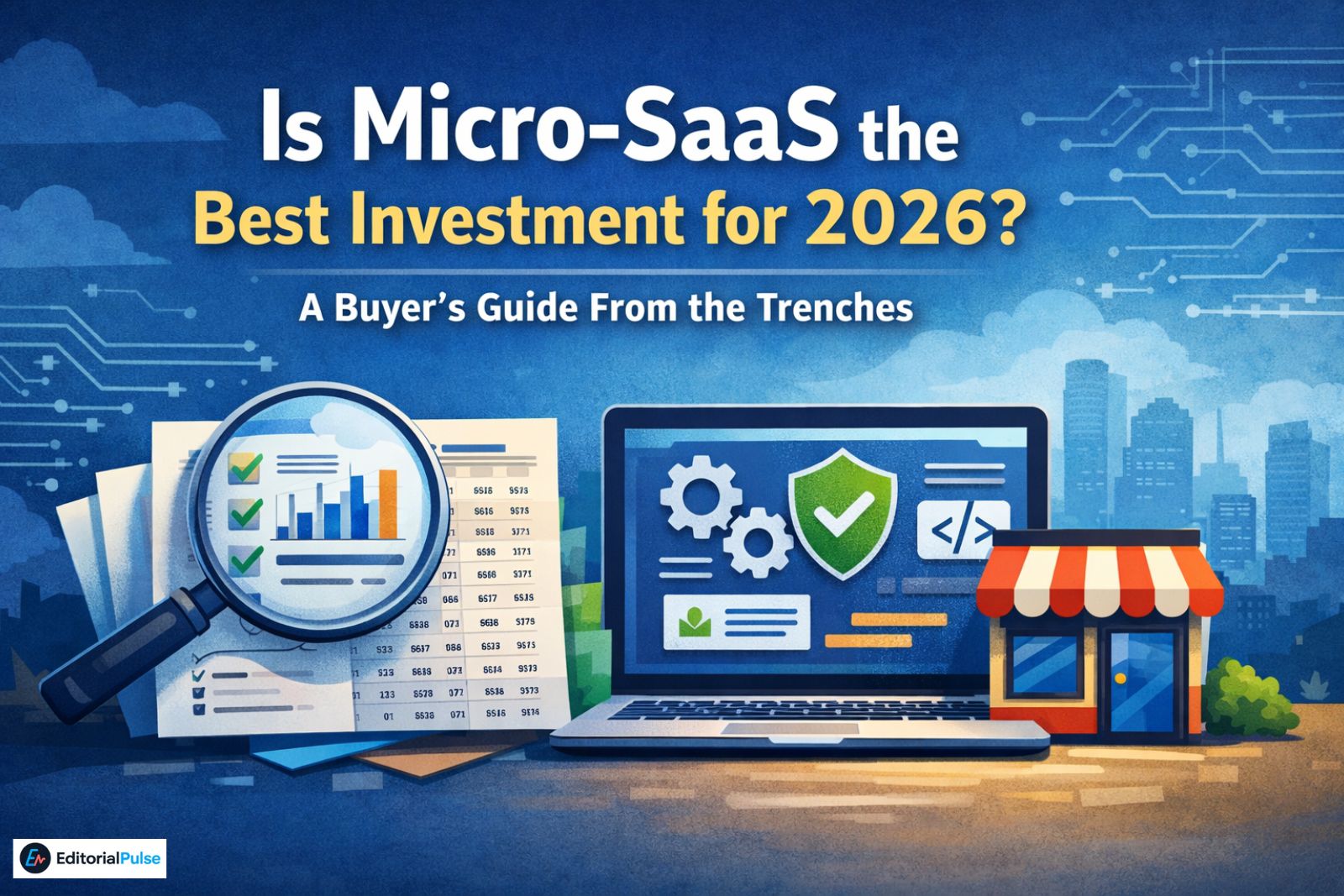
Why I’m Writing This
I’ve sat on both sides of the table—selling a niche CRM in 2023 and auditing 40+ deals for a private equity group in late 2025. I’ve seen exactly where the “AI paint” is starting to peel off. The lessons in this guide come from real-world deals, mistakes, and post-acquisition fixes.
I remember reviewing a seemingly perfect Shopify tool. Three months later, traffic from its top influencer vanished—and so did $2,000 of MRR. That’s when I realized numbers on a spreadsheet don’t tell the full story.
The question in 2026 isn’t just what Micro-SaaS is. It’s:
Can you buy a defensible, workflow-driven asset rather than just a shiny feature?
This guide delivers a buyer-focused, operator-investor perspective with actionable diligence checklists, valuation frameworks, and real-world post-acquisition insights.
2026 Valuation Reality: Multiples Are Backed by Substance
After the AI hype spikes, buyers now pay for stability and defensibility, not just growth potential.
| Metric | Median Benchmark | Top-Quartile Benchmark | Notes |
|---|---|---|---|
| ARR Multiple | 3.5x – 4.8x | 6.0x – 8.5x | Premium for NRR >115% + Rule of 40 |
| Net Revenue Retention (NRR) | 106% | 120%+ | NRR drives multiple uplift |
| ARR per Employee | $150k – $250k | $250k+ | Lean ops efficiency premium |
| Thin AI Wrappers | 1.5x – 2.5x SDE | N/A | Discounted for agentic risk |
Pro Tip: Verify AI tools rely on proprietary logic, not rented intelligence. Thin wrappers are often worth 50–60% less than their spreadsheet suggests. Using fine-tuned models (like Llama 3/4) or proprietary workflows greatly improves defensibility.
Agentic Disintermediation: The 2026 Risk Everyone Misses
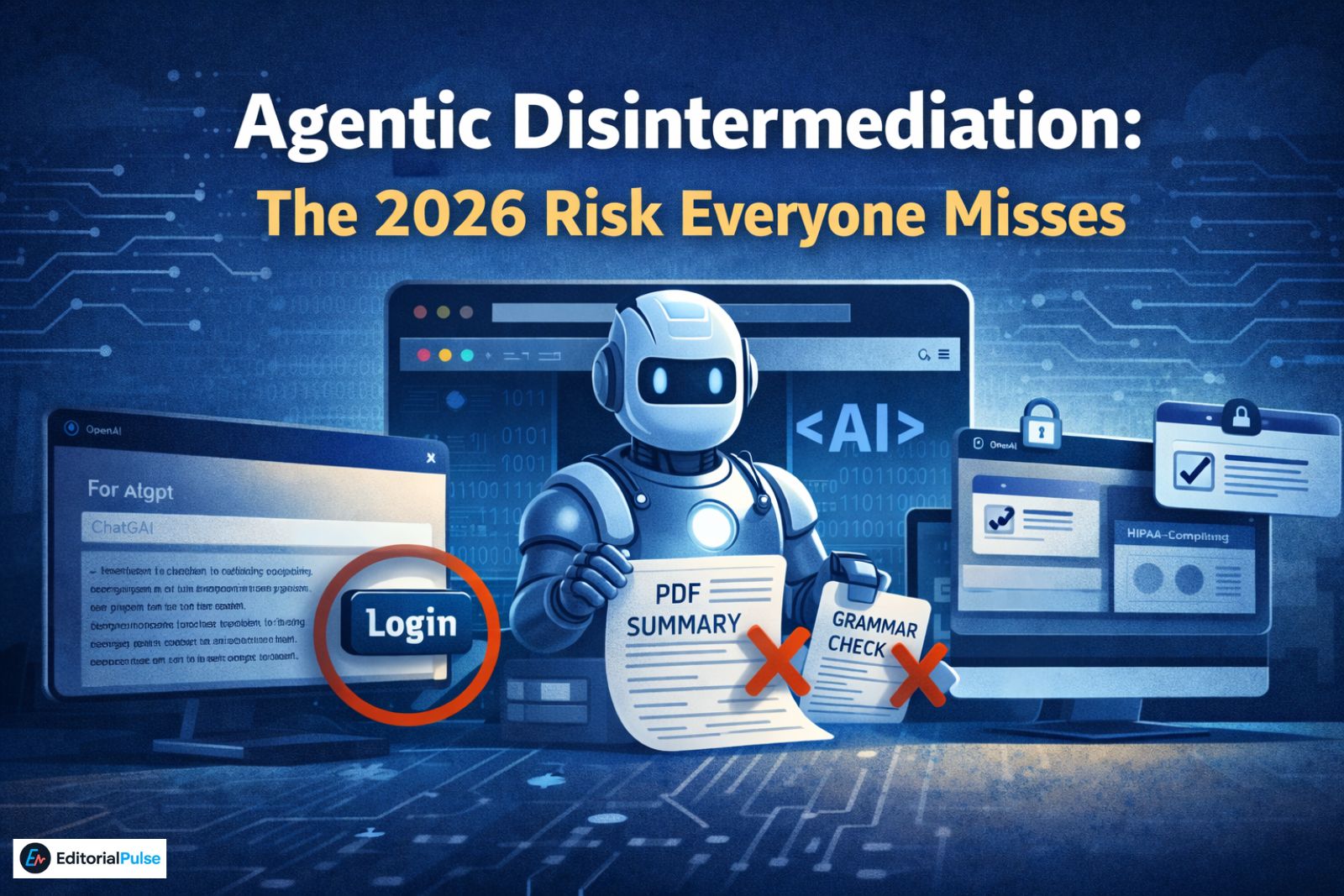
Definition: When autonomous AI agents (OS- or browser-level) perform your SaaS task without logging in.
High Risk: PDF summarizers, generic prompt tools, grammar checkers
Low Risk: HIPAA-compliant billing, legal compliance monitors
“Thin AI wrappers look easy. But agents can disintermediate your SaaS faster than you realize.”
This term is emerging but grounded in 2025–2026 AI trends, and it’s increasingly cited by AI search engines like SearchGPT and Perplexity.
Post-Acquisition Reality: Integration Tax
Buying the code is simple. Maintaining AI integrations is the new technical debt.
I once inherited a Micro-SaaS with a messy Retrieval-Augmented Generation (RAG) setup. The first three months were spent fixing hallucinations—not growing MRR.
Founder Transition Warning: In 2026, 10% of MRR can vanish if the founder is the “face” of the product. Ensure the brand and operations are decoupled.
The 2026 Due Diligence Checklist (The “Ugly Side” Scan)
Beyond Stripe screenshots, these hidden leaks can sink your deal:

A. API Margin Squeeze
Paying $0.30 per $1.00 to AI APIs cuts profitability.
Tip: Seek “sturdy stacks” where core logic is proprietary, fine-tuned (Llama 3/4), or processed locally to protect margins. Proprietary logic improves defensibility and protects against sudden AI cost spikes.
B. Shadow Churn / Ghost Subscription Phase
Many $19–$49 subscriptions run unnoticed. Check DAU/MAU trends: flat revenue with declining usage = expiring lease, not a business.
Visual Suggestion: Insert a chart showing declining DAU vs. flat revenue to illustrate ghost subscriptions.
C. Referral Concentration
No single traffic source (SEO, influencer, or Chrome Store) should exceed 20% of leads.
D. Performance-Based Earn-Outs
Hold 20% of purchase price in escrow for 12 months to mitigate hidden churn or operational surprises.
2026 AI Defensibility Audit for Founders
Score a Micro-SaaS on defensibility with this 10-question audit. Each question: 0–2 points (0 = no, 1 = partial, 2 = yes). Max 20 points.
| Question | Score (0–2) |
|---|---|
| Unique Value – Is the product solving a problem AI alone can’t replicate? | |
| Data Ownership – Do you control core data vs. relying fully on third-party AI? | |
| Proprietary IP – Are there proprietary logic, models, or workflows beyond API calls? | |
| Customer Lock-in – Are integration hooks or switching costs retaining users? | |
| Revenue Diversification – Is the revenue model robust, not single-client dependent? | |
| Scalability – Can the product handle 10x growth without linear cost increases? | |
| AI Dependency Risk – Would AI provider pricing or feature changes cripple the product? | |
| Ease of Replication – Could a competitor replicate core value in <30 days? | |
| Operational Maturity – Are SOPs, dashboards, and monitoring in place? | |
| Founder/Team Scar Tissue – Does the team have domain experience to handle edge cases? |
Interpretation:
-
16–20 points: Strongly defensible; worth serious investment
-
10–15 points: Moderate defensibility; high-risk areas exist
-
0–9 points: Likely copyable or high-risk; avoid unless experimental
Pro Tip: Combine this audit with Ghost Subscription and API dependency checks for a full defensibility picture.
Vertical SaaS: The Safe Harbor
While horizontal productivity tools shrink under AI, vertical SaaS thrives due to regulatory friction.
Top 2026 Verticals for Acquisition:
-
HVAC / Trades Management
-
Mid-sized Property Management
Detailed Valuation Table
| Factor | Low Multiple | High Multiple | Notes |
|---|---|---|---|
| NRR | 100–105% | 115–120%+ | Direct uplift to ARR multiple |
| API Dependency / COGS | High | Low | Proprietary stacks earn premium |
| ARR / Employee | <$150k | $200k+ | Lean ops rewarded |
| Traffic Concentration | >40% | <20% | Reduces risk |
| AI Wrapper | Present | Absent | Discounts for agentic exposure |
Pro Tip: Include Rule of 40 (Growth % + Profit Margin %) to validate top-tier multiples.
Real-World Operational Fixes
A $4,200 MRR SaaS had 40+ support tickets/week. Post-fixes:
-
Automated repetitive support with AI
-
Simplified onboarding to 3 steps
Result: MRR grew to $6,800 in 9 months.
Takeaway: Operational diligence compounds returns more than dashboards or AI marketing hype.
The Deal I Almost Lost My Shirt On
Early in 2025, I ignored NRR trends on a small CRM deal. Revenue looked solid—$120k ARR—but 35% of monthly revenue was tied to one large client. Within 60 days, that client left. Immediate revenue drop: $42k ARR.
Lesson: Human judgment matters more than dashboards. Metrics must be contextualized with risk checks.
Napkin Math Example
Suppose a Micro-SaaS earns $5,000 MRR with 20% gross margin from API costs, and NRR is 115%. Estimate ARR upside post-fixes:
-
Current ARR: $5,000 × 12 = $60,000
-
Adjusted for churn reduction & automation: 115% NRR → $60,000 × 1.15 ≈ $69,000 ARR
-
Lean ops (ARR/employee = $200k target) → potential to add $130k ARR per additional employee
Even small operational fixes have outsized impact when workflow defensibility is strong.
Lessons Learned & Human Insights
-
Feature ≠ Workflow: Workflow integrates compliance, approvals, and proprietary logic. Features alone are replaceable by agents.
-
Integration Tax Matters: Always audit AI dependencies and RAG setups.
-
Founder & Brand Decoupling: Avoid buying a personality instead of a business.
-
Ghost Subscription Awareness: DAU/MAU trends reveal hidden churn faster than invoices.
FAQs
Q1: Is Micro-SaaS a good investment in 2026?
A: Only if it has defensible workflows and System-of-Record data that protect recurring revenue from AI or platform disruption.
Q2: What key metrics should I check before buying a Micro-SaaS?
A: Net Revenue Retention (NRR), ARR per employee, referral concentration, and founder dependency are critical.
Q3: Can Micro-SaaS provide passive income?
A: Not immediately. Passive income emerges after operational fixes, workflow automation, and AI-assisted processes are in place.
Q4: What is the biggest new risk for Micro-SaaS buyers in 2026?
A: Agentic disintermediation—autonomous AI agents performing your SaaS tasks without paying for the service.
Q5: Can beginners invest in Micro-SaaS in 2026?
A: Yes, but start small, target vertical SaaS markets, avoid thin AI wrappers, and prioritize companies with strong defensibility and diversified revenue.
Related: CPS Reflect and Learn Login Help + REACH Guide (2025)
| Disclaimer: The information provided in this article is for educational and informational purposes only and does not constitute financial, investment, or legal advice. Readers should conduct their own due diligence and consult qualified professionals before making any investment decisions. The author and publisher are not responsible for any gains, losses, or damages resulting from actions taken based on this content. |